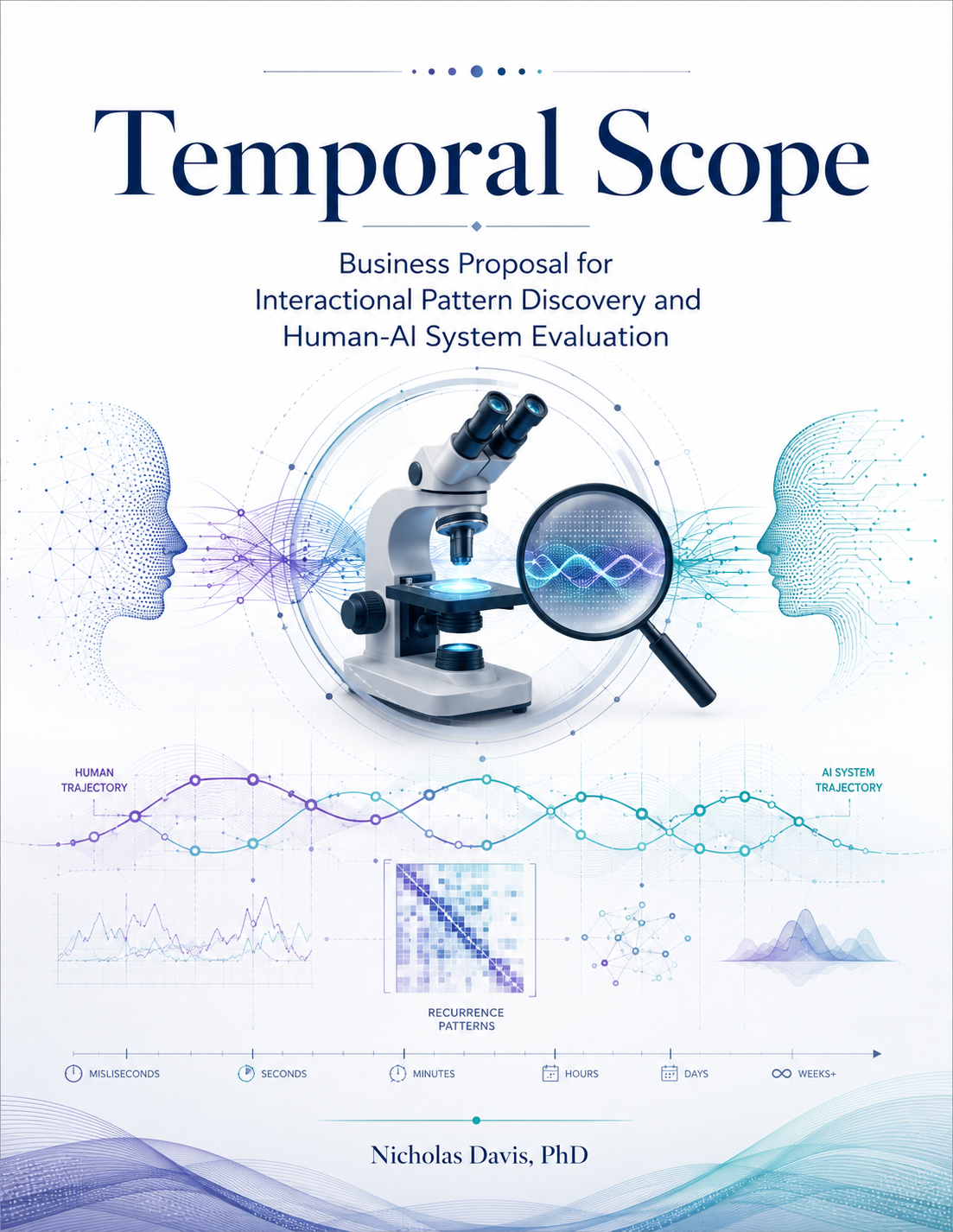
A new class of analytic system for extended human–AI interaction.
Organizations are rapidly deploying AI into complex workflows, but most evaluation systems still emphasize isolated outputs, aggregate performance, task completion, sentiment, accuracy, latency, and user satisfaction. These measures can reveal whether a system performed well overall, yet they often fail to show how an interaction became successful, how coordination deteriorated, why a breakdown occurred, or how the human and AI recovered.
Its central use case is query-by-example discovery of recurring human–AI interaction patterns. A user can identify a moment of coordination, hesitation, confusion, drift, breakdown, repair, or creative convergence and ask: “Where else did this happen?”
AI evaluation sees outcomes, but often misses the interactional process.
Outputs replace trajectories
Most evaluation tools assess discrete responses and final outcomes rather than the developing process through which the human and AI influence one another.
Important patterns lack names
Researchers often recognize hesitation, escalation, repair, convergence, or drift before they possess a formal label or classifier.
Incidents remain anecdotal
Manual transcript review may explain one case, but it cannot easily determine whether a failure is isolated, systemic, recurring, or associated with a particular context.
Success is difficult to reproduce
Teams may know that a collaboration succeeded without knowing which interaction pattern produced that success or whether it can be repeated.
Select a moment. Find its relatives. Compare what happened next.
Review
Inspect a temporal representation of the interaction.
Select
Drag across a meaningful interval on the chart.
Search
Retrieve structurally similar episodes.
Compare
Examine contexts, trajectories, outcomes, and predicted continuations.
The system is designed to answer questions such as: Where else did the human and AI become synchronized? Did this repair pattern occur before? Is this an isolated anomaly or a recurring interaction regime? What normally happens after this configuration? What distinguishes successful repair from failed repair?
Interaction microscope plus search engine.
An interaction microscope
Inspect raw human and AI trajectories, predictions, attractors, coupling, divergence, regimes, recurrence, drift, synchronization, repair, and future development.
A query-by-example search engine
The analyst does not need to formulate a mathematical query or create a predefined label. The selected interval becomes the query.
An explanatory layer
Compare local, regional, and global structure, temporal lag, contextual conditions, downstream consequences, and alternative outcomes.
Discovery before formalization
Meaningful phenomena can be investigated before the organization has enough examples or theoretical clarity to build a classifier.
Why existing approaches are insufficient.
Aggregate dashboards
Useful for monitoring scale and performance, but they flatten temporal organization and cannot reveal whether coordination was stable, intermittent, deteriorating, or repaired.
Manual transcript review
Rich in context, but slow, difficult to scale, inconsistent across analysts, and weak at cross-session retrieval.
Predefined classifiers
Effective when a target phenomenon is already well specified, but less useful when patterns are newly observed, context dependent, or interactional.
Generic motif search
Can detect repeating shapes, but usually does not preserve dyadic structure, multiscale context, repair dynamics, or downstream consequences.
A focused entry point with broad long-term applicability.
Human–AI research laboratories
Discover recurring phenomena, compare cases, develop operational definitions, and generate testable hypotheses.
AI product and UX teams
Identify correction loops, user-friction patterns, onboarding problems, disengagement precursors, and successful adaptation.
AI evaluation and assurance teams
Investigate whether difficult episodes are isolated, recurring, escalating, or repairable.
Collaborative and creative AI platforms
Study convergence, initiative transfer, fixation, productive divergence, and co-creative flow.
The proposal recommends beginning with human–AI interaction research and evaluation rather than positioning Temporal Scope as a generic time-series platform from the outset.
Concrete applications tied to measurable business value.
Interaction breakdown analysis
Locate recurring divergence, identify what preceded it, and compare which AI responses intensified or repaired the problem.
Successful repair discovery
Distinguish effective recovery strategies from unsuccessful variants and produce reusable training examples.
Recurring user friction
Find clarification loops, repeated corrections, and patterns preceding abandonment or reset.
Creative convergence
Study unusually coordinated human–AI trajectories and compare their downstream creative outcomes.
Comparative system evaluation
Compare models, interfaces, or response strategies using full interaction trajectories rather than final task scores alone.
Pattern-to-prediction analysis
Use similar historical episodes to estimate likely continuations, including breakdown, recovery, disengagement, or successful completion.
A clear hierarchy of claims.
Query-by-example
Search by selecting the phenomenon directly from the chart.
Dyadic analysis
Treat the interaction—not only the human or AI—as the unit of analysis.
Multiscale interpretation
Distinguish local resemblance from regional and global temporal organization.
Context and prediction
Compare what happened before, what followed, and which continuation is historically most plausible.
From imported data to an operational pattern library.
Import
Load conversational, behavioral, physiological, sensor, state-estimate, task, or system-event data.
Explore
Inspect raw signals, synchronized playback, regimes, coupling, drift, recurrence, and predictions.
Select
Define a meaningful interval, signal set, context window, normalization, and scale.
Search
Rank strong matches, variants, weak matches, and probable false positives.
Compare
Inspect aligned trajectories, component similarity, lag, regime, context, consequences, and prediction.
Interpret
Assign exploratory labels such as drift, repair, escalation, convergence, or disengagement precursor.
Operationalize
Export episodes, reports, visualizations, candidate libraries, and classifier-development data.
The MVP should prove one complete interaction.
Essential capabilities
- Import paired Human and AI data
- Plot raw trajectories
- Select a query interval
- Search and rank occurrences
- Display aligned comparisons
- Show preceding and subsequent context
- Separate Human, AI, and joint similarity
- Save, label, and export motifs
High-value secondary capabilities
- Synchronized playback
- Regime and attractor visualization
- Drift and coupling metrics
- Prediction-only regions
- Occurrence clustering
- Cross-session search
- Pattern libraries
- Team annotation
Multiple paths from expert service to scalable platform.
Research software licensing
Annual individual, laboratory, institutional, and multi-site research licenses.
Enterprise evaluation platform
Private deployment, access control, team workspaces, cross-session search, audit trails, custom metrics, APIs, and governance controls.
Consulting and analysis services
Recurring-pattern discovery, breakdown and repair analysis, comparative model evaluation, design recommendations, and risk/opportunity reports.
Sponsored research and pilots
Targeted studies in collaborative AI, creative AI, tutoring, robotics, safety evaluation, and adaptive interfaces.
Pattern-analysis API
A later API could embed Temporal Scope matching and comparison functions into enterprise evaluation pipelines.
Demonstrate the category before attempting to scale it.
Demonstrate
Show one visible event, query-by-example retrieval, contextual comparison, different continuations, and an actionable finding.
Pilot
Work with teams that have repeated tasks, long-form interactions, and known breakdown or repair events.
Build a library
Accumulate reusable patterns such as clarification loops, drift, repair, convergence, escalation, and stabilization.
Integrate
Move into product evaluation, model comparison, QA, safety review, incident analysis, and system design.
Validate retrieval quality, analyst usefulness, prediction, and product impact.
Search validity
Measure top-ranked precision, expert agreement, false-positive rate, normalization robustness, and stability across timescales.
Analytical usefulness
Test whether analysts find more relevant episodes, work faster, agree more often, and produce stronger recommendations.
Predictive usefulness
Determine whether identified patterns meaningfully predict success, correction, recovery, abandonment, escalation, or sustained coordination.
Product impact
Assess changes in task completion, satisfaction, correction frequency, recovery, continuity, efficiency, and redesign decisions.
Keep the product concrete, narrow, evidence-based, and privacy-conscious.
Too abstract
Mitigation: lead with “Select a moment. Find similar moments. Compare what happened next.”
Perceived as generic motif search
Mitigation: emphasize paired Human–AI analysis, relation, context, outcomes, repair, and continuation.
Similarity mistaken for explanation
Mitigation: display context, consequences, component similarity, and uncertainty rather than claiming automatic causality.
Insufficient temporal data
Mitigation: support event-derived interaction signals as well as richer multimodal datasets.
Overly broad market
Mitigation: begin as a temporal discovery and evaluation platform for human–AI interaction.
Privacy and governance
Mitigation: prioritize local processing, private deployment, de-identification, access control, and configurable retention.
Shift AI evaluation from isolated responses to organized interaction.
The next generation of AI evaluation will need to examine adaptation, mutual influence, coordination, temporal dependency, breakdown, repair, participation, and trajectory formation. Temporal Scope provides infrastructure for that transition.
Read or download the complete business proposal.
The full proposal includes the detailed product, market, validation, commercialization, and strategic arguments, along with the extended Collaborative Temporal Science material included in the submitted document.
Bring a real interaction problem to Temporal Scope.
Use recurring-pattern discovery to investigate breakdown, repair, adaptation, user friction, or collaborative performance in your own Human–AI data.